Fluid Balance Chart
1. Units in Part A Numeracy
A fluid balance chart is a 24-hour clinical document used to track a patient’s total fluid intake and output, crucial for preventing overload or dehydration. It records oral, intravenous, and food intake against urine, vomit, and drain losses.
The formula is:
Fluid Balance = Total Intake (mL) - Total Output (mL)
Fluid balance calculations are an important part of the NMC CBT numeracy assessment. A fluid balance chart records a patient’s fluid intake and fluid output, usually over a 24-hour period, and helps nurses monitor whether the patient is maintaining an appropriate fluid balance. Fluid intake may include oral fluids and intravenous (IV) fluids, while fluid output may include urine, vomit, aspirate and drainage. In the CBT exam, the intake and output values may already be recorded on the chart, and you may be asked to calculate the patient’s overall fluid balance. Formula: Fluid Balance = Total Intake (mL) − Total Output (mL) A positive (+) balance means intake is greater than output, while a negative (−) balance means output is greater than intake. Look at below chart and Find out balance,Example-1,
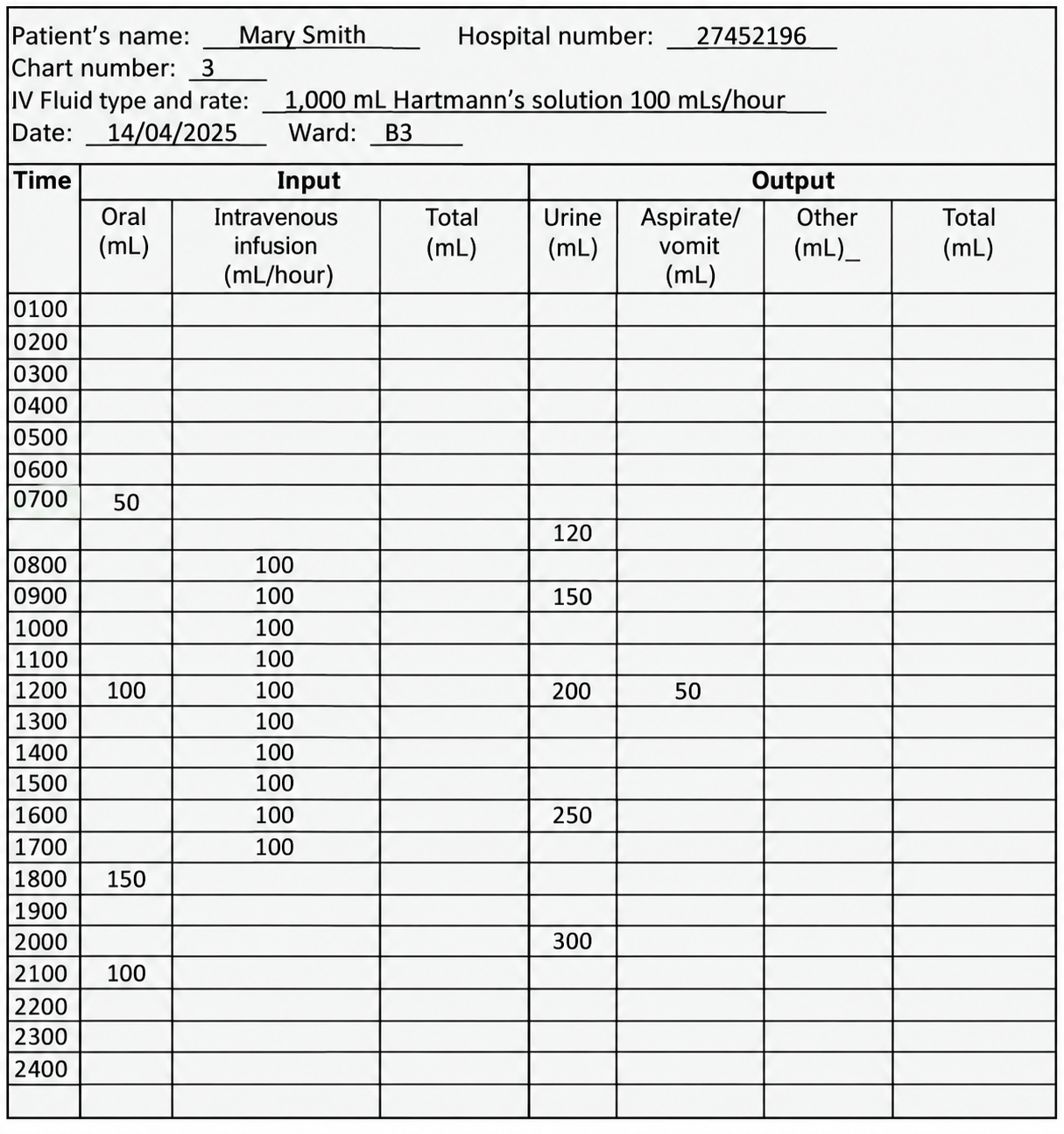
Total Input: 1400 mL
Total Output: 1070 mL
Balance= Input - Output
1,400 mL − 1,070 mL = +330 mL
+330 mL (positive fluid balance).
Example-2,
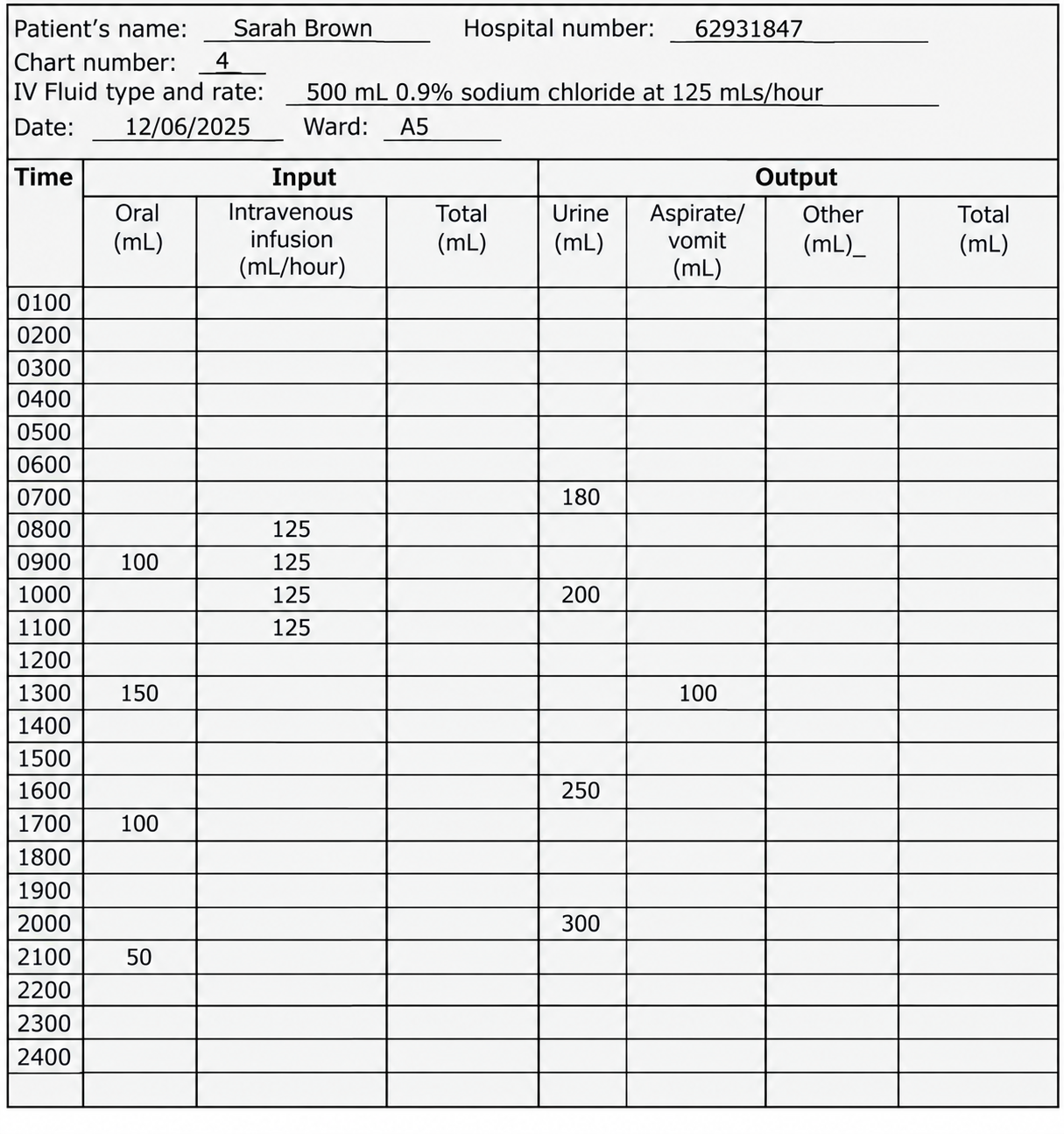
Total intake = 900 mL
Total output = 1,030 mL
Fluid Balance = Total Intake − Total Output
900 mL − 1,030 mL = −130 mL (Negative fluid balance)